
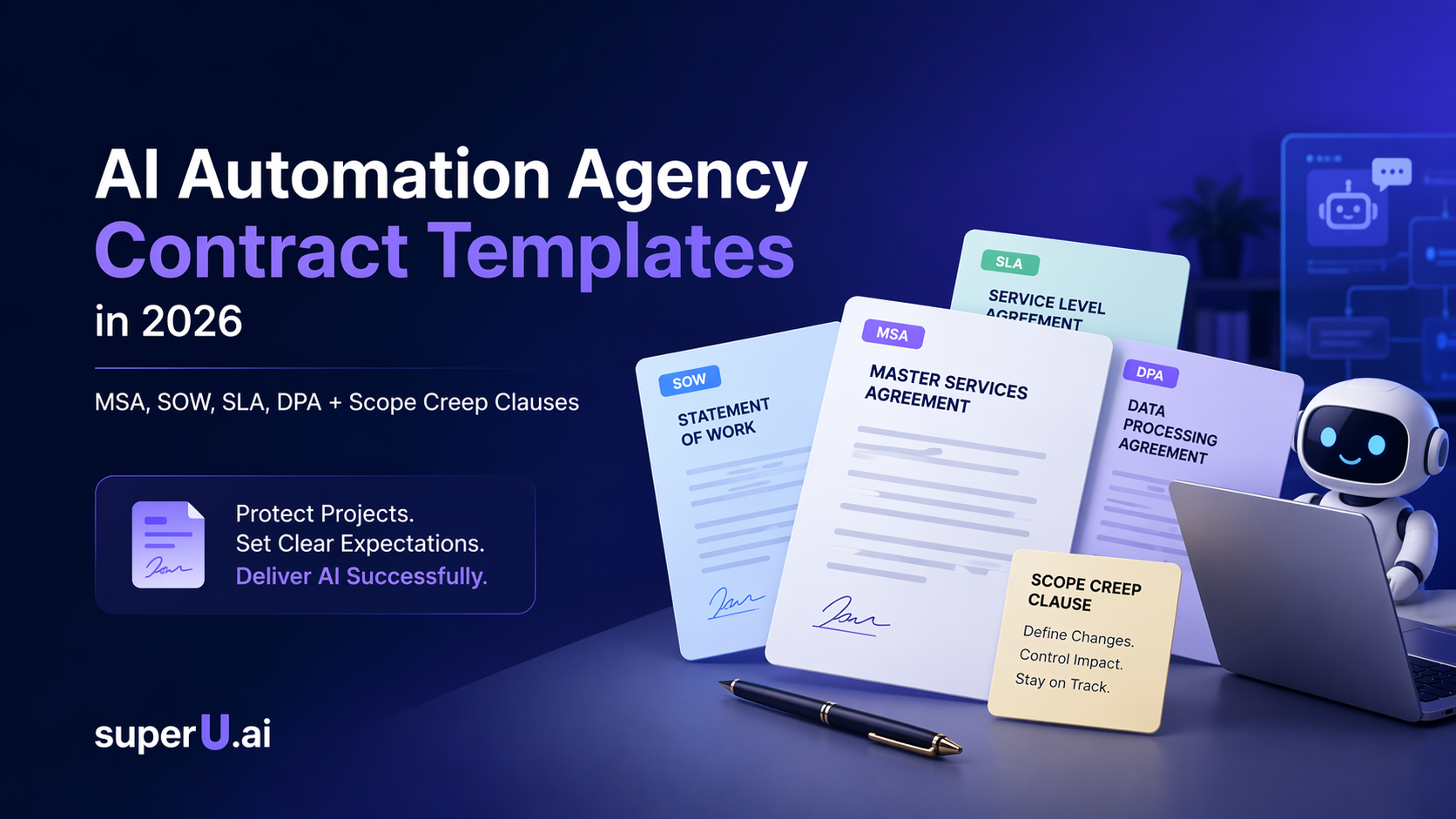
Running an automation business without solid contracts is like deploying a production workflow without monitoring: it works—until it doesn’t. In 2026, clients expect faster delivery, clearer outcomes, and tighter data/security controls—especially when AI touches customer data. A strong AI automation agency contract pack helps you prevent scope creep, close deals faster, protect IP and data, and set measurable expectations for delivery, support, and results.
This guide gives you practical, copy-ready templates and clause ideas for an AI automation agency contract stack: Master Service Agreement (MSA), statement of work template (SOW), SLA template, and data processing agreement (DPA)—plus add-ons like change orders and ROI reporting language.
Disclaimer: This is educational content, not legal advice. Have a qualified attorney adapt these templates to your jurisdiction and business.
What contracts an AI automation agency needs (and why)
Most agencies lose money in one of three ways: vague scope, unclear acceptance criteria, or weak change control. The fix is a simple contract structure that separates relationship terms from project specifics.
Recommended contract set for AI workflow automation projects:
- MSA (Master Service Agreement): the “rules of the game” for payment, IP, confidentiality, liability, and general terms.
- SOW (Statement of Work): the scope document that defines deliverables, milestones, and acceptance criteria (your best scope-creep prevention tool).
- SLA (Service Level Agreement): support response times, uptime targets (if applicable), maintenance windows, and what’s excluded.
- DPA (Data Processing Agreement): required when you process personal data through CRMs, support tools, email platforms, analytics, or AI systems.
- Change Order: the one-page process that approves any scope, price, or timeline changes.
This matters more in AI automation because clients often discover new ideas mid-build (“Can it also do X?”). Your contracts should welcome iteration—without donating labor.
The 2026 AI automation agency contract stack (recommended order)
To reduce friction during sales, send contracts in a predictable sequence. Keep the MSA stable across clients, and customize scope inside the SOW.
- MSA: after verbal alignment (pre-sign) to lock the legal terms.
- SOW: with the proposal or immediately after to confirm exactly what you’ll build and deliver.
- SLA: only if you offer post-launch support or ongoing maintenance.
- DPA: if handling personal data (common in most automation builds).
- Change Order: introduced upfront, used whenever scope changes.
If you use AI automation agency pricing with retainers, ensure your MSA and SLA clearly separate build work from run/support responsibilities.
Template 1: Master Service Agreement (MSA) outline (copy-ready)
Use this outline as your automation agency MSA structure. Keep it consistent; place client-specific details in the SOW.
1) Parties and definitions
Define key terms so there’s no ambiguity later: Services, Deliverables, Client Materials, and Third-Party Tools (Zapier/Make, OpenAI, CRMs, ticketing, analytics, etc.).
Clause idea (Third-Party Tools):
Services may integrate third-party software and APIs. Client acknowledges third-party terms, pricing, rate limits, outages, and changes may impact performance. Agency is not responsible for third-party downtime or policy changes.
2) Term, renewal, and termination
Cover the start date, renewal terms (especially for retainers), termination for convenience (with notice), and termination for cause.
Clause idea (handover on termination):
Upon termination, Agency will provide reasonable transition assistance as a billable service at Agency’s then-current rates unless included in the applicable SOW.
3) Fees, invoicing, and late payment
State payment terms (Net 7/14/30), deposits, late fees, and your right to pause work for non-payment.
Clause idea (pause for non-payment):
Agency may pause Services if any invoice is more than X days overdue. Project timelines will be adjusted accordingly.
4) Intellectual property (IP)
A common 2026-friendly approach: the client owns paid-for deliverables; you retain your pre-existing IP (templates, libraries, internal frameworks); and you license any background components embedded in deliverables.
Clause idea (Background IP):
Agency retains all rights in pre-existing materials, templates, and know-how used to deliver Services (“Background IP”). Client receives a non-exclusive license to use Background IP solely as embedded in the Deliverables.
5) Confidentiality
Use standard mutual NDA-style language. If you work with regulated data, align confidentiality with the DPA and security schedule.
6) Warranties and disclaimers (important for AI)
AI outputs can be probabilistic. Your MSA should clarify review responsibilities and limit implied guarantees.
Clause idea (AI output disclaimer):
Client acknowledges that AI-generated outputs may be inaccurate or incomplete and must be reviewed by Client prior to use. Agency does not warrant that AI outputs are error-free or compliant with any specific regulatory requirement.
7) Limitation of liability
Typical structure: liability cap at fees paid in the last X months; exclusion of indirect, consequential, or special damages.
8) Security and access responsibilities
Tie security commitments to onboarding and cooperation. Make it clear what you do, what the client must do, and how delays affect timelines.
Clause idea (Client cooperation):
Client will provide timely access to systems, accounts, and personnel as reasonably required. Delays caused by Client may extend timelines and may result in additional fees.
9) Publicity (optional)
If you want to use logos or case studies, require written approval and define what’s allowed.
Template 2: Statement of Work (SOW) template (copy/paste)
A strong statement of work template prevents misunderstandings and accelerates delivery. Keep it concise (often 2–6 pages) and make deliverables testable.
SOW Section A — Project overview
Project Name: __________
Goal: describe the business outcome (not just tasks).
Primary KPI(s): e.g., reduce lead response time from 4 hours to 5 minutes.
SOW Section B — In-scope deliverables
List deliverables as testable artifacts. For AI workflow automation, specify triggers, actions, error handling, and logging.
Example deliverable format:
- Workflow #1: Lead Intake → Qualification → CRM Update
- Triggers: web form submission, inbound email, chatbot
- Actions: enrichment, CRM create/update, Slack alert
- Logging: centralized sheet/database log + failure alerts
SOW Section C — Out-of-scope (scope guardrails)
This is where scope creep is prevented before it starts. List common items that clients assume are included.
- Copywriting and creative production
- CRM migration or data cleansing
- Custom application development outside automation platforms
- 24/7 support unless defined in the SLA template
- New workflows not listed in the In-scope section
SOW Section D — Assumptions & client responsibilities
Tie these to your client onboarding checklist so projects don’t stall.
- Client provides admin access to required tools within 3 business days
- Client provides sample data, field mappings, and an approval contact
- Client tests in staging before production rollout (where applicable)
SOW Section E — Milestones, timeline, and acceptance criteria
Acceptance criteria should be verifiable. This protects both sides and reduces churn.
- Milestone 1: Architecture + mapping approved (client signs off on workflow diagram + field mapping)
- Milestone 2: Build completed (automated run passes test cases A, B, C)
- Milestone 3: Production launch + training (training delivered; runbook provided)
SOW Section F — Pricing and payment schedule
Include your AI automation agency pricing model: fixed fee with milestone payments, or retainer with defined monthly deliverables. If you use retainers, define what happens to unused hours (rollover vs expire).
SOW Section G — Change control (mini version)
Any request that materially changes scope, timeline, or complexity requires a written Change Order signed by both parties.
Template 3: Change Order (scope creep control) template
This one-page document is your key defense against margin leakage. Introduce it early so clients know the process is normal.
Change Order #: ________
Requested by: ________
Description of change: ________
Reason / business impact: ________
Added deliverables: ________
Impact on timeline: +__ days/weeks
Impact on fees: +$__ (or +__ hours)
Approval: Client sign ________ Date ____ | Agency sign ________ Date ____
Scope creep clause (add to MSA or SOW)
Use clear scope creep clauses that keep relationships healthy:
Requests not explicitly listed in the SOW are out-of-scope. Agency may, at Client’s request, provide a written estimate and Change Order. Agency is not obligated to begin out-of-scope work until the Change Order is executed.
Template 4: SLA template (support + maintenance)
If you offer post-launch support, an SLA template is essential—especially when automations depend on third-party APIs.
1) Coverage hours
- Support hours: Mon–Fri, 9am–5pm (Client time zone)
- Exclusions: weekends and holidays unless purchased as an add-on
2) Incident priority levels
Define severity tiers so response expectations are unambiguous:
- Sev 1: Core workflow down with revenue or operational impact (Response: 2 hours, Target resolution: 1 business day)
- Sev 2: Partial failure; workaround exists (Response: 8 hours, Target resolution: 3 business days)
- Sev 3: Minor bug; cosmetic/logging issue (Response: 2 business days, Target resolution: next release)
3) What’s included
- Break/fix support for delivered workflows
- Minor adjustments up to a defined limit (e.g., X hours/month)
- Monitoring checks and alerting (if offered)
4) What’s excluded
- New workflows or major redesigns (handled via Change Order)
- Third-party vendor outages and policy changes
- Client-side configuration changes that break integrations
5) Maintenance windows
State when you may deploy updates and when the client can expect planned downtime (if any).
Template 5: Data Processing Agreement (DPA) essentials
If you touch personal data in CRMs, email platforms, support tools, analytics, or AI systems, you likely need a data processing agreement (DPA). The DPA should match how your automations actually operate.
Minimum DPA elements to include:
- Roles: Client as Controller, Agency as Processor (most common)
- Processing details: categories of personal data, data subjects, purposes, and duration
- Security measures: access control, encryption, least privilege, logging
- Subprocessors: list your automation platform(s) and AI providers
- International transfers: if applicable (and the mechanism used)
- Breach notification: timelines and responsibilities
- Deletion/return: what happens to data after termination
Clause idea (subprocessors):
Client authorizes Agency to engage subprocessors as necessary to provide Services. Agency will maintain an up-to-date list of subprocessors upon request.
Add these clauses for AI automation projects (2026 realities)
1) Performance boundaries (avoid “guaranteed results”)
Clients want outcomes. You can support that with measurement and reporting—without guaranteeing revenue.
Clause idea (outcome language):
Agency will implement automations designed to improve operational efficiency. Client acknowledges business outcomes may be affected by factors outside Agency’s control (traffic, offer, sales process, data quality, third-party tools).
2) Logging and auditability
Logging is your best friend for support and billing clarity. Include execution logs, failure alerts, retries, and audit trails where needed.
3) Human-in-the-loop approvals
For sensitive actions (refunds, cancellations, compliance communications), require approvals and define who is responsible for timely sign-off.
Clause idea (approvals):
Certain automations may require human approval before execution. Client is responsible for timely approvals; delays may impact performance.
4) Model/API change risk
AI providers change models, costs, and limits. Your contract should define how remediation happens.
Clause idea (provider change risk):
Client acknowledges AI model behavior, availability, and pricing may change. If changes materially impact workflows, Agency will propose remediation via Change Order or under the SLA if applicable.
Contract language for ROI reporting (protects both sides)
If you provide reporting, define the method so no one argues about “what counts.” Tie this to a clear ROI reporting dashboard deliverable.
Define:
- Source of truth (CRM, billing system, data warehouse)
- Attribution rules (first-touch vs last-touch, assisted conversions)
- Frequency (weekly/monthly) and access requirements
Clause idea (reporting limitations):
Reports are based on available data provided by Client systems. Agency is not responsible for inaccuracies caused by incomplete tracking, misconfigured analytics, or data entry errors.
Practical contract pack: what to include in your client folder
A clean folder reduces friction and speeds up signature cycles:
- 00 - Signature Page (if separate)
- 01 - Master Service Agreement (MSA)
- 02 - Statement of Work (SOW)
- 03 - Service Level Agreement (SLA)
- 04 - Data Processing Agreement (DPA)
- 05 - Change Order Template
- 06 - Runbook + Access Map (post-launch)
Common mistakes that cause churn (and how your contracts prevent them)
- Vague deliverables: fix with acceptance criteria in the SOW.
- “Unlimited revisions” expectations: fix with Change Orders and clear inclusions.
- Support ambiguity: fix with an SLA and severity levels.
- Data compliance surprises: fix with a DPA and clear subprocessors.
- Misaligned timelines: fix with client responsibilities and access deadlines.
Use this checklist before you send contracts
- SOW deliverables are testable and measurable
- Out-of-scope section exists (and is realistic)
- Change Order process is one page and easy to sign
- SLA clearly defines coverage hours and response times
- DPA covers subprocessors, security, and deletion
- AI disclaimers included (accuracy and provider changes)
- Payment terms and pause-for-nonpayment clause included
Final note: contracts are a sales asset, not just legal armor
The best agencies use contracts to reduce anxiety. When prospects see clear scope, support boundaries, and a straightforward change process, they’re more likely to sign—and stay. Pair these documents with a strong client onboarding checklist and measurable reporting so clients see value quickly and consistently.
