
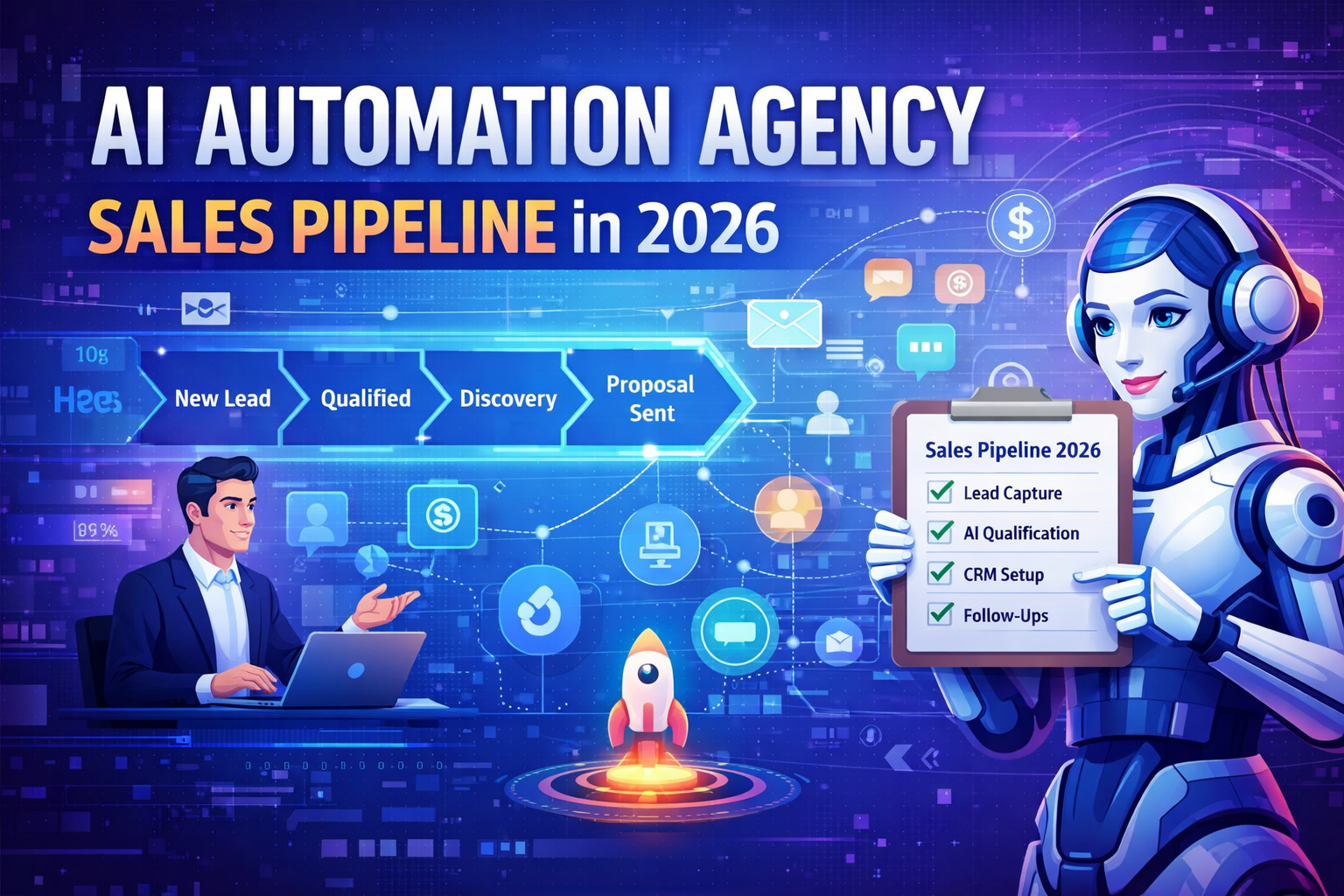
Running an AI automation agency in 2026 isn’t just about building workflows—it’s about building a repeatable system that turns qualified leads into paying clients. If your calendar is packed one month and empty the next, the root cause is usually an inconsistent agency sales pipeline, not a lack of leads.
This guide gives you a modern, practical sales pipeline you can implement fast: a simple agency CRM setup, clear qualification rules, a discovery call script, an automation proposal template, and a follow-up sequence you can automate without sounding robotic.
Why you need a standardized sales pipeline (not “more leads”)
Many agencies try to fix sales by pushing harder on outreach. But consistent revenue usually comes from operational discipline: clear pipeline stages, a single source of truth, and predictable follow-up. When your process is standardized, your marketing compounds instead of resetting each month.
A reliable AI agency sales pipeline includes:
- Defined stages with “exit criteria” (everyone knows what “done” means)
- A CRM for agencies that tracks owner, next step, and due dates
- Fast lead routing and consistent follow-up automation
- A repeatable discovery → proposal → close workflow
The 7-stage sales pipeline for an AI automation agency (simple + scalable)
Copy these stages into your CRM today. Each stage has a clear definition so your team (or future hires) can run the same process every time.
1) New Lead
Done when: the lead is captured and the source is tagged (inbound, outbound, referral, partner).
2) Qualified Lead
Done when: they meet minimum criteria (budget, authority, use case, urgency). This is where AI lead qualification saves time and improves consistency.
3) Discovery Booked
Done when: a meeting is scheduled and confirmation is sent (including agenda and expectations).
4) Discovery Completed
Done when: pain points, current process, stakeholders, timeline, constraints, and success metrics are documented in your CRM.
5) Proposal Sent
Done when: scope, price, timeline, and a clear next step are delivered with a decision deadline. Use a standard automation proposal template so proposals don’t vary by mood or memory.
6) Negotiation / Decision
Done when: objections are handled and procurement/legal steps are underway (or a clear “no” is received).
7) Closed Won / Closed Lost
Done when: payment and onboarding handoff are initiated (won) or the loss reason is recorded (lost). Tracking loss reasons is how you improve client acquisition over time.
Stage 1–2: Lead capture + AI-assisted qualification
What to collect on every lead
Whether leads come from a form, a calendar link, or an intake chatbot, capture consistent data so your sales funnel automation can work reliably:
- Name, email, company, role
- Current tools (CRM, helpdesk, email, data sources)
- Primary use case: “What are you trying to automate?”
- Urgency (this month / this quarter / exploring)
- Budget range (even broad ranges help qualify faster)
AI lead qualification rules (fast and consistent)
A simple scoring model is enough to improve speed and reduce wasted calls. Example scoring:
- +2 if they mention revenue impact (lead response time, conversion rate, retention, churn)
- +2 if they already use automation tools (Make, n8n, Zapier, HubSpot)
- +1 if they have clear volume (tickets/day, leads/week, invoices/month)
- +1 if a decision-maker will attend discovery
- -2 if they ask for “an AI chatbot” but can’t define the workflow
If score ≥ 3 → move to Qualified Lead. If score < 3 → send a nurture email and ask 1–2 clarifying questions.
Stage 2–3: Agency CRM setup (what to track and how)
Your CRM is your system of record. The goal isn’t complexity—it’s clarity. A good CRM for agencies makes the next step obvious and follow-ups unavoidable.
Minimum viable CRM fields
Whether you use HubSpot, Pipedrive, Close, Airtable, or a lightweight Notion CRM, include these fields:
- Lead source
- Pipeline stage
- Use case category (support automation, sales ops automation, onboarding, internal ops)
- Estimated deal value
- Next step + due date (mandatory)
- Stakeholders (decision-maker, champion)
- Discovery notes and success metrics
Recommended CRM views for sales execution
- Today’s Follow-ups (due today)
- Discovery scheduled this week
- Proposal sent (no response in 48 hours)
- Decision stage (stalled > 7 days)
Stage 3–4: Discovery call script (built for automation projects)
A strong discovery call is not a product demo. It’s a diagnosis tied to outcomes. Use this discovery call script for a 30–45 minute call.
1) Set the frame (2 minutes)
“Here’s the plan: I’ll ask a few questions about your current process, where it breaks, and what success looks like. If it’s a fit, I’ll suggest a next step and we can decide together.”
2) Identify the workflow and pain (10 minutes)
- “Walk me through what happens from start to finish.”
- “Where does it slow down or break?”
- “What’s the cost—time, missed revenue, churn, errors?”
3) Quantify (5–10 minutes)
- “How many times per week does this happen?”
- “How long does it take today?”
- “Who is involved, and what’s the opportunity cost?”
4) Current tools and constraints (5 minutes)
- “What systems are involved (CRM, email, Slack, helpdesk, database)?”
- “Any compliance requirements (SOC 2, HIPAA, retention)?”
5) Define success (5 minutes)
- “If we solved this in 30 days, what changes?”
- “What KPI would you use to call this a win?”
6) Close on next step (3 minutes)
“I’ll send a proposal with two options: a quick-win workflow and a scaled version. If it aligns, we’ll finalize scope and start onboarding.”
Stage 4–5: Automation proposal template (copy/paste)
The fastest way to improve close rate is to standardize your proposal. Keep it short, measurable, and decision-friendly. Use this automation proposal template structure:
1) Summary (what you heard)
- Current state
- Pain points and impact
- Desired outcome and KPIs
2) Proposed solution (what you will build)
Break the build into modules so the buyer can visualize the deliverables:
- Module A: Intake + routing
- Module B: Data enrichment + validation
- Module C: Notifications + logging
- Module D: Reporting + monitoring
3) Deliverables (make it tangible)
- Workflow diagram
- Automations built in Make, n8n, or Zapier (plus AI components where useful)
- Testing, error handling, and monitoring basics
- Documentation + handoff playbook
- Training session
4) Timeline (simple and credible)
- Week 1: Design + access
- Week 2: Build + internal QA
- Week 3: Pilot + fixes
- Week 4: Launch + monitoring
5) Pricing + options (help them choose)
Offer 2–3 tiers to reduce negotiation and make decisions easier:
- Starter (Quick Win): 1 core workflow
- Growth: 2–3 workflows + reporting
- Scale: multi-department rollout + SLA
6) Assumptions + access required
List what you need (admin access, API keys, point of contact, timeline constraints).
7) Next step (make it binary)
“Reply ‘Approved’ and we’ll send the invoice and kickoff link.”
Stage 5–6: Follow-up sequence (where deals are won)
Most deals are lost to silence, not competitors. The fix is a default follow-up sequence that runs every time a proposal is sent. This is the simplest form of follow-up automation that increases close rates without adding more meetings.
A simple 7-touch follow-up sequence (14 days)
- Day 0 (send proposal): “Sent the proposal—happy to walk through it. Do you prefer Option A or B?”
- Day 2: “Any questions on scope or timeline? If helpful, I can revise around your constraints.”
- Day 4: Share a relevant mini-case study or KPI lift from a similar automation project.
- Day 7: “Do you want to move forward this month, or should we revisit next month?”
- Day 10: “If timing isn’t right, I can keep this open—but I’ll pause unless you tell me otherwise.”
- Day 14 (breakup): “Should I close this out?”
How to automate your agency sales pipeline (without making it fragile)
The goal is to remove manual busywork while keeping human judgment where it matters. Start with automations that reduce admin time and enforce follow-up.
Automations to implement first
- Lead → CRM auto-create (form submission or inbound email)
- Auto-tagging by source (UTM, referral, dropdown)
- Auto-assign owner (round robin or by niche)
- Meeting booked → stage update + reminders
- Proposal sent → follow-up tasks + email sequence
- Closed won → onboarding handoff (kickoff email + access checklist)
Weekly KPI dashboard (what to measure)
If you only track one thing, track stage conversion rates. That’s how you identify where your client acquisition system is leaking.
Core sales pipeline KPIs
- Lead → Qualified Lead rate
- Qualified Lead → Discovery booked rate
- Discovery completed → Proposal sent rate
- Proposal sent → Closed won rate
- Average sales cycle length
- Average deal size
Useful benchmarks (directional)
- Qualified Lead → Discovery booked: 40–70%
- Proposal → Close: 15–35% (higher with strong inbound and referrals)
Why AI automation deals stall (and how to fix them)
1) The buyer can’t picture the deliverable
Fix: include a workflow diagram and a deliverables checklist in every proposal.
2) The workflow isn’t tied to business value
Fix: put KPIs in the first paragraph of the proposal and restate them during the proposal review call.
3) Too many options
Fix: present two options, not five.
4) No decision-maker
Fix: confirm stakeholders in discovery and invite the decision-maker to the proposal review.
Tool stack for 2026 (pick what you’ll maintain)
- CRM: HubSpot, Pipedrive, Close (or Airtable for advanced ops)
- Scheduling: Calendly
- Proposals: Google Docs, PandaDoc
- Automation: Make, n8n, Zapier
- Internal handoff: Notion, ClickUp
FAQ
Do I need a full CRM to start?
No. But you do need a system with stages, owners, and next-step dates. A full CRM becomes essential once you’re juggling more than ~15 active opportunities.
What’s the fastest way to increase close rate?
Standardize discovery and follow-up. Most agencies improve conversion just by making post-proposal follow-up consistent.
How do I price if scope is unclear?
Use a paid discovery or a fixed “quick win” package that produces a measurable result and reveals the real scope.
Next steps: implement this pipeline in 60 minutes
- Create the 7 pipeline stages in your CRM
- Add the minimum viable fields (source, use case, next step)
- Paste the discovery call script into your call notes template
- Save the automation proposal template as a reusable doc
- Add the 14-day follow-up sequence as tasks or email automation
Once your pipeline is consistent, your outreach, conversions, and delivery finally start compounding—without adding chaos.
Also Read: How AI Agents Are Replacing the Sales Funnel in 2025
