
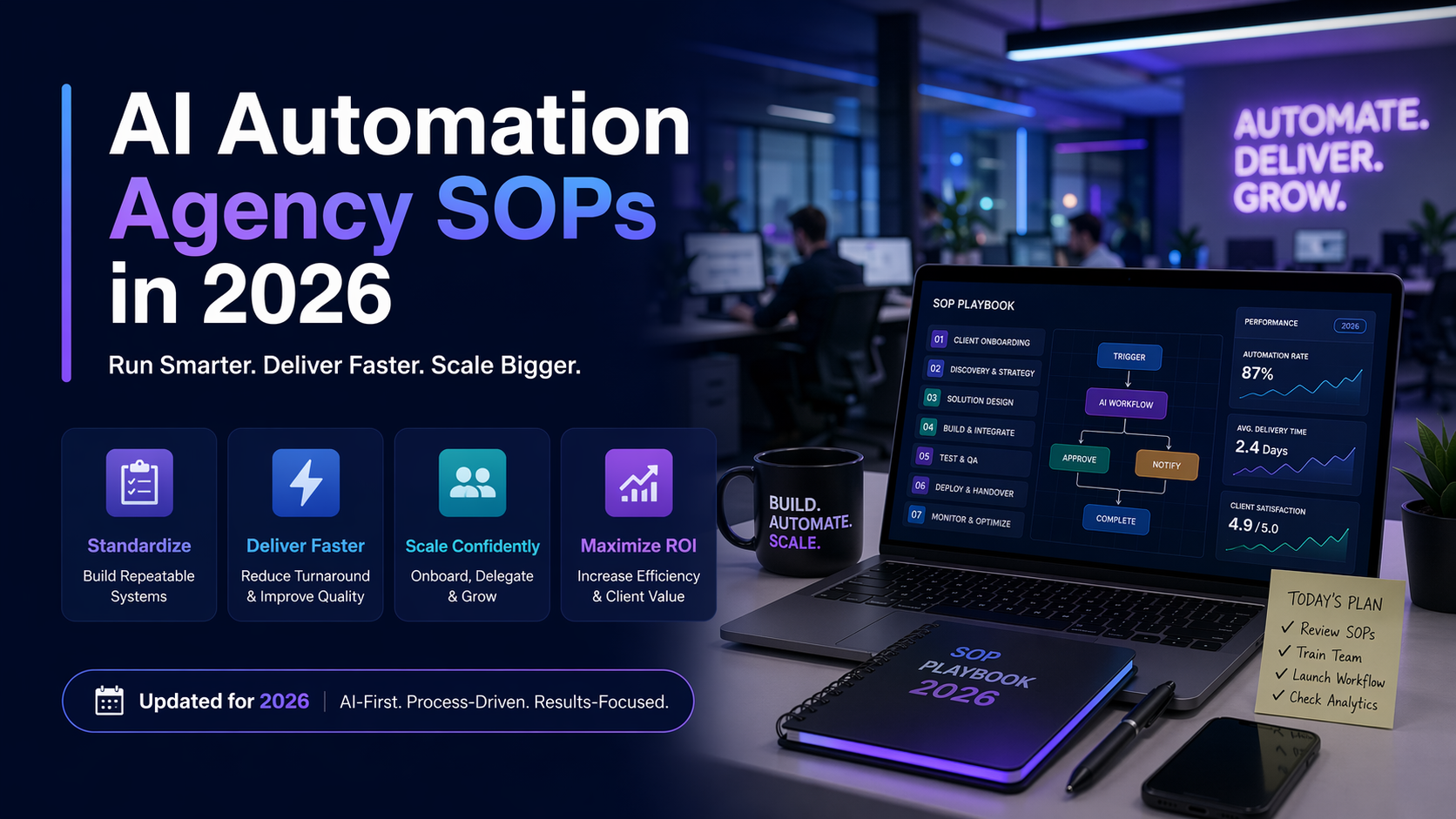
Running an AI automation agency gets chaotic fast: custom builds, shifting client requests, tool sprawl, and delivery timelines that slip because "everyone knows what to do"… until they don’t.
That’s why AI automation agency SOPs (standard operating procedures) are your unfair advantage in 2026. They help you deliver consistent outcomes, onboard clients and team members faster, prevent scope creep, and scale beyond a founder-led operation.
In this guide you’ll get a practical SOP playbook you can copy, including a reusable standard operating procedures template, checklists, and a recommended framework for workflow documentation and continuous improvement.
What is an SOP in an AI automation agency?
An SOP is a documented, repeatable method for completing a task—written clearly enough that a trained team member can follow it without guessing.
In an AI automation agency, SOPs typically cover both:
- Client-facing workflows (sales, onboarding, delivery, reporting)
- Production workflows (build standards, testing, deployment, monitoring, security)
The best SOPs are living documents: they’re updated after each project as you learn what breaks, what delays delivery, and what improves results.
Why SOPs matter more in 2026 (AI + automation complexity)
AI-powered automations are not set-and-forget. Clients expect reliability, compliance, explainability, and measurable ROI. Strong workflow documentation and SOP discipline help you:
- Deliver consistent outcomes across clients and industries
- Reduce key-person risk (delivery doesn’t stop if one builder is unavailable)
- Prevent scope creep with documented change control
- Improve margins by reducing rework, missed requirements, and unclear acceptance criteria
- Onboard new hires and contractors faster (days, not weeks)
- Create productized services using repeatable packages
SOP documentation framework (copy this structure)
Use the same format for every SOP to keep your knowledge base easy to navigate and to make audits, handoffs, and training simpler.
Standard operating procedures template (recommended)
- SOP name (example: Client Onboarding – Kickoff to Access Provisioning)
- Goal (what success looks like) with a clear SLA
- Scope (when to use it / when not to use it)
- Owner + contributors (who maintains it)
- Inputs + prerequisites (what must be true before starting)
- Step-by-step procedure (numbered steps + screenshots or Loom links)
- Quality checks (acceptance criteria before marking done)
- Tools + links (Notion/Confluence doc, Slack channel, CRM record, repo link, dashboard)
- Exceptions + escalation (what to do if access is delayed, data is missing, or scope changes)
- Version history (date, change summary, who updated)
The core SOP library every AI automation agency should have
Below are the SOPs that most directly impact revenue, delivery speed, churn prevention, and profitability.
1) Lead capture + qualification SOP
Goal: Ensure every inbound/outbound lead is captured, scored, and routed within 24 hours.
Steps (example):
- Capture lead in CRM (form, inbound email, LinkedIn, referral)
- Assign owner and set first-response SLA (example: 4 business hours)
- Use a qualification scorecard (budget, authority, need, timeline, data readiness)
- If qualified, book discovery call and send pre-call questionnaire
- If unqualified, send a not-now sequence and tag for retargeting
Quality checks: Every lead has a status, next step, and next contact date.
2) Discovery call + solution mapping SOP
Goal: Convert ambiguous requests into a clear automation roadmap.
Discovery outputs:
- Problem statement and current workflow map
- Success metrics + ROI hypothesis
- Data sources + constraints
- Risk list (security, compliance, uptime requirements)
Tip: Keep a standardized discovery doc so the delivery team doesn’t re-interview the client.
3) Proposal + scope definition SOP
Goal: Ship proposals that are consistent, scoped, and measurable.
Include in every proposal:
- Deliverables (what you will build)
- Out of scope (what you won’t build)
- Assumptions (access, data quality, response time)
- Timeline + milestones
- Acceptance criteria
- Pricing model + payment schedule
This SOP pairs directly with your statement-of-work workflow and is a key building block for scope creep prevention.
4) Contracting + compliance SOP
Goal: Sign faster while reducing legal and security risk.
Checklist:
- MSA/SOW attached and consistent with proposal
- Data processing terms (if applicable)
- Security requirements noted (SOC 2, GDPR, HIPAA depending on client)
- Support SLAs defined (response times, uptime targets)
- Change request process included
5) Client onboarding SOP (kickoff → access → success criteria)
Goal: Start delivery with clear goals, access, and timelines.
Client onboarding checklist (copy/paste):
- Confirm stakeholders + decision-maker
- Confirm communication channel (Slack Connect / email) and meeting cadence
- Confirm success metrics and what done means
- Collect access to tools (CRM, email, calendar, data warehouse, ticketing)
- Collect API keys and store securely
- Confirm environments (dev/staging/prod)
- Confirm documentation sources (existing SOPs, screenshots, recorded demos)
- Confirm go-live rules (approval gates, rollback plan)
This is where a strong client onboarding checklist prevents most delivery delays.
6) Delivery execution SOP (build → test → deploy)
Goal: Produce reliable automations with predictable timelines.
Delivery stages:
- Requirements finalization (freeze scope for sprint)
- Workflow design (diagram + tool selection)
- Build (versioned config + documented prompts)
- QA testing (unit tests + end-to-end test plan)
- Client review (demo + feedback captured)
- Deployment (staged rollout + monitoring enabled)
Quality checks:
- Testing completed and documented
- Monitoring and alerts configured
- Client sign-off recorded
This SOP defines your default service delivery process.
7) Change requests + scope control SOP
Goal: Keep projects profitable and timelines stable.
Change request workflow:
- Log request (what changed, why, urgency)
- Classify (bug vs enhancement vs new scope)
- Estimate effort + impact on timeline
- Provide options (defer, swap scope, paid add-on)
- Get written approval (email/DocuSign)
- Update SOW backlog and invoicing if needed
This is the operational backbone of scope creep prevention.
8) QA + reliability SOP (automation health standards)
Goal: Reduce failures, retries, and client escalations.
Standards to document:
- Logging format (what every automation must log)
- Error handling (retries, dead-letter queues, alerts)
- Rate limits and fallbacks
- Prompt and version control for LLM steps
- Data validation rules
- Stop-the-line criteria (when to disable an automation)
9) ROI reporting + QBR SOP
Goal: Prove value, retain clients, and expand accounts.
Monthly reporting checklist:
- Volume metrics (runs, tasks completed)
- Reliability (success rate, failure reasons)
- Time saved estimate (hours)
- Cost impact (labor, tools, reduced churn, faster pipeline)
- Business outcome metrics (leads, appointments, revenue attribution where possible)
Tie this to a client-ready ROI reporting dashboard so stakeholders see value without extra meetings.
Quarterly Business Review (QBR) agenda:
- Wins + metrics
- Issues + fixes
- Roadmap for next quarter
- Expansion opportunities
10) Offboarding + handover SOP
Goal: Make exits clean (and reputation-positive), reduce risk, and create reactivation potential.
Offboarding steps:
- Confirm end date and final deliverables
- Provide documentation pack (workflow diagrams, credentials handoff process)
- Export configs where possible
- Remove access (least privilege)
- Archive logs/data per policy
- Post-mortem: what to improve
SOPs to add if you want to scale beyond 5–10 clients
Once your core SOP library is stable, add these to increase leverage and reduce risk:
- Hiring + contractor onboarding SOP (accounts, tool access, coding standards)
- Security incident response SOP (breach, token leak, suspicious activity)
- Tooling governance SOP (approved tools list, evaluation process)
- Template management SOP (versioning and updating reusable workflows)
- Client communication SOP (status updates, escalation paths)
Tools to manage SOPs (simple, scalable setup)
Choose tools your team will actually use. Consistency beats perfection.
Common stack:
- Notion / Confluence / Google Docs for workflow documentation
- Loom for quick walkthrough videos
- Jira / Linear / Trello for delivery workflows
- Slack for daily comms + incident channels
If your service offering depends heavily on integrations, document your AI automation agency tech stack inside each SOP (tools, permissions, environments, and ownership).
How SOPs connect to templates and productized services
SOPs are how you turn custom consulting into repeatable revenue.
If you already use AI workflow automation templates, SOPs ensure:
- The template is deployed consistently
- QA standards are the same across clients
- Reporting is standardized
- Change requests don’t destroy margins
This also supports clearer packaging, like automation agency pricing packages based on tiers (starter, growth, scale) with defined deliverables and limits.
SOP implementation plan (7 days to operational clarity)
Day 1: Create SOP index + naming conventions
Day 2: Document sales → proposal → contract flow
Day 3: Document onboarding + access collection
Day 4: Document delivery stages + QA
Day 5: Document change requests + escalation rules
Day 6: Document reporting + QBR
Day 7: Run a process retro and update based on reality
Keep it lightweight: the best SOP is the one your team follows.
FAQ: AI automation agency SOPs
How detailed should an SOP be?
Detailed enough that a competent team member can complete the task without asking for clarification—while still short enough to be usable. Use bullet steps and add Loom links for anything complex.
How often should SOPs be updated?
At minimum, after every project retro. In fast-moving AI stacks, expect to update key delivery SOPs monthly.
What’s the fastest SOP to write that makes the biggest difference?
Onboarding + access collection, followed by change request handling. Both remove the most common delivery blockers.
Final takeaway
If you want predictable delivery, lower churn, and higher margins in 2026, SOPs are not busywork—they’re the system.
Start with the core SOP library (sales → onboarding → delivery → reporting), keep it versioned, and treat each client project as a chance to refine your process.
